Thursday, February 1, 2018

9 Profitable Online Businesses That Can Be Started For Less Than $500 (Updated For 2018)

Profitable Online Businesses

Here’s a BIG myth that needs to be busted…

Starting a business costs a lot of money.

That just isn’t true anymore.

Starting a business does NOT have to cost a lot of money. Not these days.

Yet people still have the misconception that it does.

Massive opportunity exists on the internet right now and it’s like nothing we have ever seen. In fact, the internet has completely leveled the playing field.

An individual working out of their living room can now compete with the big players—and they can start their business for less than $500.

Not only is the start-up cost low, but the potential to earn is incredible.

And that’s not all. Because the internet has opened up the entire world, there are so many other advantages to operating an online business:

  • The ability to run a business from ANYWHERE.
  • Access to consumers from across the globe.
  • The ability to sell 24/7, which means making money while sleeping!
  • Potential to run multiple businesses at the same time.
  • Automation, freeing up the business owner’s time.

There is no other form of business that offers the benefits of an online business.

And all that is needed to start many profitable online businesses is a computer and an internet connection.

With a few basic tools, like web hosting and an email autoresponder, there is no limit to what can be achieved. And these tools are available for less than $30/month.

What can be done with these tools?

There are seven profitable online businesses that are simple to start up for less than $500. And each of these has huge earning potential.

Spoiler alert: I’ve personally used several of these models, and I grew one of them to over $10 million!

The key is to find the right model.

After all, I believe it’s important to start a real business that can last for the long haul.

A business like that has 3 important traits…

  1. It Offers Value If a business doesn’t add value to customer’s lives, then it’s not going to last – and it’ll be a miserable experience trying to keep it going.
  2. It’s Scalable The best online business models (including these 7) can be started on a small scale, even as a part time “side hustle” and eventually grow into a large business.
  3. It’s Possible To Systematize – We’re looking for freedom here, not a new job with more responsibility. The best online business models can break the link between time and income, which means more free time for the owner.

The 7 business models below have all 3 characteristics, as long as the right system is implemented.

7 Profitable Online Businesses You Can Start For Less Than $500

Profitable Online Businesses

Twenty years ago, no one would have guessed that starting a business would be so simple and so inexpensive. Yet today, there are seven online business models that make that possible.

These businesses include:

  1. Affiliate Marketing
  2. Digital Publishing
  3. eCommerce
  4. Coaching and Consulting
  5. Blogging
  6. Amazon Kindle
  7. Freelancing and Creating an Agency

There is such variety here. Chances are, anyone can find at least one of these businesses that suits their talents and their interests. There is at least one they will enjoy.

So, let’s go through each one in detail and see what these online business opportunities are all about…

1. Affiliate Marketing

Profitable Online Businesses

Affiliate marketing is perhaps the easiest, quickest, and best way to start an online business.

Affiliate marketing is basically selling other people’s products and getting a commission for every sale.

I personally recommend getting into affiliate marketing by building an email list. In fact, that’s exactly how I made my first money online.

The first $100 I made online was promoting an affiliate offer. I’ve never been more excited than I was after making that first sale.

Today, I make over five million dollars a year just through affiliate marketing—and affiliate marketing is only a secondary part of my business.

One of the courses I help sell costs $999 and I get a 50% commission on each sale I make. That means that for every course I sell, I take home $499 of pure profit!

It’s also possible to sell affiliate products with a blog, Youtube videos, niche websites, and more.

The best part about affiliate marketing is that there’s no need to create an original product

That means the creator of the product does most of the heavy lifting on the front end. They create the product, the sales pages, delivery for the product, and more.

The role of the affiliate is to simply get new leads to the product’s sales page.

It’s easy to scale— Instead of having to spend a bunch of time creating new products, all affiliate marketers have to do to scale is find new products to promote.

The possibilities for growth are tremendous—There is no limit to the number of affiliate offers that can be promoted. The number of people that can be targeted is staggering.

It doesn’t get any better than that. And I have developed a system anyone can use to get started with affiliate marketing…

3 Simple Steps to Get Started With Affiliate Marketing

Profitable Online Businesses

Step 1 – Build an Audience

Email marketing is the best way to build an audience. Create a free gift, set up an opt-in page, and drive traffic to that page. These subscribers can then be marketed to for this affiliate offer and any future offers.

Other ways to build an audience include creating a blog or building a following on social media. Building a relationship with followers will make it possible to attract them to the affiliate offer.

Step 2 – Find a Product and Sign Up

To promote a product honestly and genuinely, it is best for an affiliate to actually like and/or use that product.

All the best affiliates search out these types of products and promote them. Because when they like it, they can truly talk about how great the product is. They can sell it with 100% confidence.

Once the ideal product is found, simply sign up for the merchant’s affiliate program. There are marketplaces like Clickbank and JVZoo that make it easy to find and promote affiliate programs.

Check out this post for a giant list of affiliate marketplaces.

Step 3 – Sell and Earn

Once an affiliate is signed up with the merchant’s program, it’s time to sell that product to the audience. A commission will be earned on each sale. And depending on the affiliate program, that commission could be as high as 50%, 60%, or even 70%.


But there are some additional things to know that will help bring success to any affiliate marketing efforts…

Keys To Affiliate Marketing Success

Profitable Online Businesses

These are just a few last tips that will help ensure an affiliate marketing campaign is successful:

Pick the right niche—Pick the most popular niches. These are areas where a lot of people are actively looking for information to solve their problems.

The best niches also have a lot of products to promote. For example, personal development is a niche rich in affiliate products, while politics is not, even though politics excites people’s emotions.

Here are some niche ideas:

  • Health
  • Dieting
  • Fitness
  • Personal Development
  • Dating
  • Pet Training
  • Cooking
  • And pretty much anything else you can think of!

That’s just the tip of the iceberg, we have a post featuring 77 niche ideas for digital marketing!

Find great offers to promote—The best place to start looking for offers is on websites like ClickBank and JvZoo. These are affiliate sites that are filled with offers to promote.

Build an audience—The best way to build an audience is through email marketing. Create a free gift, create an opt-in page, and bring traffic to the site.

Promote the chosen offers—Develop strong sales copy skills. These skills will allow anyone to write in a way that gets readers to take action.

Affiliate marketing is one of the best (if not the best) ways for somebody who is brand new to online business to get started.

It’s where I started, and it works just as well today as it did back then.

To achieve awesome success in affiliate marketing, start with our FREE Digital Bootcamp.

2. Digital Publishing

Profitable Online Businesses

Digital publishing is another very powerful online business.

In fact, this is the largest part of what Lurn does!

Digital publishing is about developing and selling information products. These products include things like eBooks, videos, audio recordings, membership programs, and live events. Digital publishing is incredibly flexible. And like affiliate marketing, it is open to any niche.

And it is so much more accessible today than it used to be.

In the past, it was difficult to get into the publishing business. To create information products and ship them was a vast undertaking. It cost a lot of money and took a lot of time to:

  • Write
  • Produce the product (i.e. type setting and printing)
  • Market the product
  • Mail it out
  • Make corrections if needed (which meant reprinting the product)

These days, the whole process is digital and automated. Selling 1,000 products requires no more effort or resources than selling one product. And that means an increase in profits without an increase in effort.

Plus, once the product is created, that’s it. It will always be there. Product creation is a one-time effort. Even if revisions or updates need to be made, it is a simple matter of making changes to the file.

However, when getting into digital publishing, it is important to go about it the right way…

3 Basic Steps of Digital Publishing

Profitable Online Businesses

There are three steps anyone starting out in digital publishing should take:

  1. Choose a niche—As with affiliate marketing, it is best for the digital publisher to choose something they are passionate about.
  2. Create a product—This can be created by the digital publisher or outsourced.
  3. Sell the product—Sell to an email list, through a social media following, and through advertising.

Here is an example of the kind of niche and product someone could create. Say they are interested in the dog training niche. This person could:

  • Record a few videos that show them training a dog
  • Edit these videos using free software
  • Package it all into a $37 course

Yes, it really is that simple!

Plus, there are plenty of services these days that will handle payment processing, tracking sales, processing refunds, and anything else associated with selling a digital product. Again, this is so simple.

In fact, the hardest part of digital publishing is the marketing. And for this reason, it is crucial that any digital publisher—and any online business owner—learn copywriting.

Now, before we move onto the next business, I want to stress the massive profit potential of digital publishing. I have created more than 20 seven-figure products using digital publishing.

How awesome is that? And the only expenses associated with digital publishing are:

  • Web hosting, such as HostGator or Bluehost
  • A website on which to sell the digital product
  • A website that delivers the digital product
  • An email autoresponder like Sendlane, Aweber, MailChimp or GetResponse

The earning potential with digital publishing is phenomenal. And there is absolutely no reason NOT to do it.

Winning Combination

Digital Publishing is a great complement to Affiliate Marketing. They can actually make each other more effective!

Here’s why. Both Digital Publishing and Affiliate Marketing involve selling information products and building an email list.

With an online brand and an audience, anyone can sell their own digital products, have affiliates promote their products and even promote other people’s products!

For example, someone in the fitness niche might have an online course (their digital publishing product). They can also have other fitness professionals promote that course as affiliates. And since it’s not optimal to promote one product 24/7, they can promote relevant affiliate products to their list as well.

Another super effective blend of Digital Publishing and Affiliate Marketing involves tripwire offers. Tripwire offers are low-ticket offers that get customers in the door. And from there, more expensive offers can be sold.

It’s really hard to get new customers. But it’s easy to turn customers into repeat buyers. Tripwire offers let prospects buy something really inexpensive, to get in the door, and turns them into customers. After taking action with a tripwire offer, people are much more likely to buy something else! That’s the key.

Here’s how it all fits together. An original information product can be a tripwire offer. Then higher ticket affiliate products (and more original products) can be sold to these customers as well.

See the incredible amount of opportunity here?

3. eCommerce

Profitable Online Businesses

It is also incredibly easy to sell physical products online.

And this is precisely what an eCommerce business does. Just think of Amazon and Ebay. They are the largest examples of eCommerce out there.

In fact, during the last quarter of 2016, Amazon generated over $47 billion in revenue! Just think about that. It just goes to show how big eCommerce is. People ARE shopping online.

But the giants aren’t the only ones making big money from selling products online.

There are many entrepreneurs that make millions of dollars every single year through eCommerce. There are different levels of eCommerce businesses. Some of these people have quite extensive websites, but many of them have simple websites and still make a lot of money.

And some even don’t have their own website! They simply use an eCommerce platform, such as Shopify. Through this platform, they can sell anything and have it shipped right to their customers.

And it has never been easier to start an eCommerce business.

With the right system, an eCommerce business can be started for less than $500.

Compare that with the thousands (or more) it would cost to start a brick and mortar retail store.

That said, I don’t talk as much about eCommerce because launching an eCommerce business will be more expensive than the other business models because we’re dealing with physical products.

Why? Because physical products need to be produced, warehoused, and shipped. Yes, there are companies that handle all of this, but the profit margins aren’t that big.

For example, after deductions are made at different points in the supply chain, a business owner might only make $3 off of a $20 product.

Other models like digital publishing and affiliate marketing have much larger margins.

That means to be profitable, eCommerce is a straight up numbers game. The good news is that people LOVE buying physical products.

Having said that, this is a business that can be extremely profitable for someone who knows what they’re doing. Honestly, eCommerce can be one of the highest earning online business models when done correctly. My wife actually runs a profitable eCommerce store.

Of course, there are some general principles to keep in mind. Like with every other online business model, it’s so important to pick a profitable niche. A niche will make or break a business. Also, it’s crucial to sell the right products.

Do some research on Amazon and Ebay to see what products are selling well in a niche. With the foundation of a good niche and good products, chances of success are much higher.

For an even more detailed guide about some common mistakes to avoid, read our article 7 Big Mistakes People Make With eCommerce.

With that in mind, here is the easiest way to get started in eCommerce:

  • Use a built-for-you website platform like Shopify—This way, all the heavy lifting is done by them and all that is left is to choose the products and sell.
  • Choose a niche—This is just like choosing a niche in affiliate marketing and digital publishing.
  • Find products—The best place to do this is through AliExpress. This is an online shopping site that takes care of the shipping. All products are sent directly from the manufacturer or distributor, which means no inventory and no warehousing needed.

To get started with an eCommerce business, I highly recommend this free webinar.

Up to this point, we have talked a lot about different types of products—other people’s products, digital products, and physical products.

However, it is also easy to set up an online business that sells services. Let’s take a look…

4. Coaching and Consulting

Profitable Online Businesses

Services are in high demand!

Anyone who has knowledge or skills that can help others can easily launch a successful coaching and consulting business.

And this is an ideal business for anyone who likes working with people.

Coaching and consulting are not new concepts. They were around long before the internet showed up on the scene.

But as with any other type of business, the internet has made it much easier to connect with potential clients in ways that were not available in the past.

First and foremost, coaches and consultants now have access to a global pool of consumers. And this means there is massive potential for success.

Again, the right niche must be chosen, one the business owner is passionate about. And some niches are immensely profitable. This is particularly the case with any type of business consulting.

Regardless of the niche chosen, working as a coach or consultant will build expertise like no other online business. When we work with others, we are always learning.

Plus, this is a business that can benefit from one-on-one work or can be scaled. Rather than working one-on-one, a coach or consultant can easily work with groups of people. This can create a massive increase in profits.

But remember, a coach and a consultant are not the same thing…

The Difference Between A Coach And A Consultant

Profitable Online Businesses

It is easy to mistake the coach and the consultant as the same thing. But this really isn’t the case. The difference between them is subtle, but there is a difference.

A consultant works with someone to find solutions in some area of life, like their career or business. An example of a consultant is a marketing consultant. This is a person who will go into a business and give their clients specific strategies on how to improve marketing.

A coach is a little different. Rather than telling people what to do, a coach helps create a framework that allows their client to figure out for themselves what they should be doing. Then the client can execute their plan.

In other words:

  • The consultant tells the client what to do.
  • The coach gives the client guidance so the client can figure out what to do.

Coaches and consultants are absolutely incredible people.

I honestly don’t know where I would be without them.

I have personally paid thousands of dollars a month to be able to work with amazing marketing consultants, business coaches, and more. That is all money well spent, because by getting that individual attention, I was able to make real breakthroughs in my life.

Over the past year, I have been working with an entrepreneur coach, and it has been one of the most profound experiences of my life. This coaching has been incredibly valuable to me as a business leader, it has been great for my company, and it has even been great for my soul!

Perhaps the most beautiful thing about coaching and consulting is the opportunity to work with people in just about any area of life. No matter the niche, there are opportunities to coach and consult with people.

I have personally met people that do coaching in:

  • Health and nutrition
  • Fitness/bodybuilding
  • Dating
  • Relationships
  • Marriage
  • Business
  • And more…

It’s Easier Than You Think

Coaching and consulting might be the easiest online business to start.

Everyone has some type of skill that other people would pay to learn. Yes, everyone. Even if someone’s only skill in the world is Excel spreadsheets, there are A LOT of people who are willing to pay to learn those skills.

Coaching and consulting requires less technical knowledge than the other business models. It can be started with just a phone and an internet connection. That’s it!

There’s one more thing that keeps people from taking advantage of this awesome business model: Selling!

Selling can be scary to some people. But it doesn’t have to be.

A lot of people don’t feel comfortable promoting themselves. With coaching and consulting, there’s no need to be pushy or “salesy.”

All it takes is for someone to be themselves and have a skill that helps people. Then, the coach or consultant can just start conversations with potential clients and show how they can help them. That’s how almost everyone gets started.

If coaching or consulting sounds like a fit, the good news is it is easy to launch a coaching or consulting business…

Simple Steps To Starting a Coaching or Consulting Business

Profitable Online Businesses

  • Choose a niche—There’s that niche again. Except this time, the key is to choose a niche in which the coach or consultant already has experience and skill. After all, it isn’t possible to direct and guide people without having the proper knowledge and experience.
  • Start reaching out to ideal prospects or run ads—Advertising is one way to attract clients. It is also possible to attract clients through other channels, such as LinkedIn, social media, or even contacts through business colleagues.
  • Have a way to speak with clients—When working with clients, whether one-on-one or as a group, there needs to be a way to speak with them directly. Be sure to set up a method of communication, such as phone, conference call, or Skype.

Here’s an inside tip: One of the most IN-Demand coaching/consulting services right now is Facebook Advertising.

Many of our students at Lurn are booking clients at an exceptional rate. And they all started with our Free Facebook Ads Bootcamp. Sign up today to really leverage the coaching & consulting business model: Free Facebook Ads Bootcamp

5. Blogging

Profitable Online Businesses

Blogging can become a lucrative business.

For those who have been living under a rock, blog is short for web-log. It’s basically a type of website that has articles posted instead of only static pages.

Honestly, every website should have a blog. They’re that important. And they can really accelerate online business success. There’s a reason why every major company in the world now has a blog. They know the potential.

Blogging is a great online business to start all by itself. But it’s even better when used in combination with some of these other businesses.

There are so many benefits to blogging:

It leverages SEO—This is a HUGE advantage. All the written content makes the blogs rank high in search engines. This has the potential to attract a lot of organic traffic, for FREE. In fact, this is more possible with blogging than with any other business models we have discussed.

Works well with other businesses—Blogging can easily be combined with any other of the businesses we are discussing here. It is so easy to implement affiliate marketing on a blog simply by adding banners with affiliate links. It is just as easy to link a blog with digital and physical products or with services offered.

Blogging is a great option for writers—Writers can take special advantage of blogging, expressing their knowledge in a way that works best for them. But those that don’t feel confident writing can still use blogging as a tool by outsourcing it to a freelancer.

Blog content is sharable—Blog content can easily go viral because it is highly sharable. It can be shared on any social media account, by the blogger and by the readers.

It is suitable for any niche— It is incredibly easy to blog about any niche under the sun. Sharing information about a specific niche is a great way to generate a following and show the skills and knowledge of an expert.

Finally, blogging is just plain fun!

The key is to post content regularly. It is important that the followers of a blog know what to expect. They must be able to rely on the fact that they will learn something new at predictable intervals.

And above all, make sure the content is valuable! People won’t come back if they don’t think the content is useful.

Content Is King

Blogging is all about content.

A blog with high-quality content is one of the best assets in the online business world.

We’re in the Information Age. People are actively seeking out information. And a blog will make any online business A LOT more visible.

And if the blog has amazing free content, people are going to be hungry to pay for whatever else is offered.

For example, someone with an excellent blog about natural health will find it very easy to sell any products related to natural health (ebooks, online courses, consulting services, health products and more).

Plus, starting a blog is pretty simple.

The Simplest Way to Start a Blog

Profitable Online Businesses

  • Choose a niche—Like always, start with selecting the niche that will work best in terms of passion and monetization.
  • Install WordPress— Buy hosting and install WordPress, which is 100% free. Most web hosting providers now have 1 click WordPress installation, which makes this step a breeze!
  • Start writing posts!—Just get going. And remember, planning blog content in advance will help ensure the content is always good and consistent.

Ways To Monetize a Blog

Profitable Online Businesses

Of course, a blog will only be a business if it is monetized. Otherwise, it is just—well—a blog. Here are some ways to monetize a blog to start earning an income:

  • Affiliate marketing
  • Digital publishing
  • Selling eCommerce products
  • Selling coaching/consulting services
  • Ads on the site

Next, let’s talk about publishing books…

6. Amazon Kindle

Profitable Online Businesses

It is SO easy to self-publish a book thanks to Amazon!

Amazon Kindle is the largest eBook marketplace in the world. In fact, it’s so big that today Amazon sells more eBooks than physical books.

This is a great option for writers. Writing eBooks and selling them can generate a lucrative income. And if someone isn’t a writer?

They can still take advantage of Amazon Kindle!

Anyone who doesn’t feel comfortable writing a book themselves has another option.

They can outsource the creation of their eBooks. Again, there are freelancers out there who are experts when it comes to writing. Simply find a writer, provide them with an outline for the book, and watch the magic happen.

One of the major advantages of publishing via Amazon Kindle is that the customers are already there! It is easy to have direct access to an audience that comes to the “store” looking for eBooks.

When I published my first edition of The Circle of Profit on Amazon, I was able to get 64,000 customers in under a week!

I did this by simply tapping into the amazing resources that Amazon provides. It’s all right there!

And publishing on Amazon is incredibly simple. Here’s how to do it:

  • Write a book on a desired topic—Again, it is easy to outsource the writing. Freelance platforms such as Upwork or iWriter are great places to find talented freelance writers.
  • Create a nice cover—Amazon has a cover builder. Another option for making a cover is to use Canva. Or it is possible to outsource the creation of the cover to Fiverr.
  • Create a free account on Kindle Direct Publishing—This is easy and only takes about 5 minutes.
  • Write good copy on the eBook’s sales page—This copy will help entice people to buy the book.

But remember, publishing an eBook via Amazon does have its drawbacks…

While it does have incredible potential, it isn’t nearly as profitable as digital publishing or affiliate marketing. This is because eBooks are so cheap on Kindle and the author only gets a percentage of the sale.

The only way to make a lot of money through Kindle is to publish A LOT of books. That, of course, is not going to be appealing to everyone to say the least.

Another disadvantage is being at the whim of Amazon. Amazon can make changes overnight that can be devastating to sellers. They can also shut anyone down whenever they want to.

The best plan is to combine publishing through Amazon Kindle with other forms of online business. This way, Amazon Kindle can be used as a lead magnet for those businesses. For example, an eBook could lead people to a coaching program or an online course.

This will provide a well-rounded approach that promises the highest profits.

And now on to the final online business model…

7. Freelancing and Creating an Agency

Profitable Online Businesses

In many of the businesses listed above, I have talked about outsourcing.

Hiring someone to write or do graphic design or some other aspect of your business is a great way to create products.

But what about the people who have those skills themselves?

Anyone who has services to sell can have a great online business as a freelancer.

But the goal isn’t just to offer freelance services. The ultimate goal should be to create an agency that offers high-quality services.

I have used agencies for a lot of different services, such as graphic design, writing, and programming.

These agencies are all real businesses that someone built. The owner isn’t doing all the work. They’ve built a team and the right systems for getting new clients.

There’s high demand right now for all of these services.

After all, for most companies, it makes more sense to contract out to these agencies as opposed to hiring somebody to do the work in-house. This way, they can avoid hiring permanent staff and paying a full-time salary with benefits.

Plus, it is incredibly inexpensive to get started as a freelancer.

It costs almost nothing. In fact, some websites, such as Upwork and Guru, have a basic membership that is free. Anyone who wants to can sign up and start bidding for jobs immediately. They can literally find work overnight.

The trick is not to simply create a job as a freelancer. Rather, the goal should be to build a business—an agency.

Ideally, a freelancer takes on enough clients and does great work so they can make a good income for themselves. But if they take on more clients than they need or can handle on their own, they can then hire other freelancers to serve those clients.

The business then becomes an agency.

With the internet, it is easier than ever to go out and get clients. As with other forms of online business, freelancers can market their services through advertising, social media, and blogging. But they also have freelance platforms through which to find clients.

Plus, there is a lot of demand for freelancers right now in many fields, such as:

  • Writing
  • Translation
  • Editing
  • Programming
  • Graphic design
  • Web design
  • Video editing
  • Photography
  • Virtual assistant
  • And more…

These are all services that can be immediately monetized for a whopping $0! And they can all start earning profit literally overnight.

Plus, anyone who works as a freelancer can also enjoy any of these other businesses. For example, a freelance writer can do the following:

  • Build an agency as described above
  • Coach others in how to launch and maintain a freelance career
  • Write books—in the freelancing niche or another familiar niche— that they can sell on Amazon Kindle
  • Write books and create other information products they can sell through digital publishing
  • Blog about their freelancing career
  • Add affiliate marketing to their business portfolio by integrating it with any of the above business models
  • Sell products on the side

Yes, as a freelancer, it is easy to engage in ALL SEVEN of the business models we have discussed here!

And when it comes to freelancing, there is one service that is in EXTREMELY HIGH DEMAND right now: Copywriting. With so much business being done online, copywriting is possibly the most valuable skill someone can have.

That’s why we’re offering a free copywriting workshop to help anyone become a great copywriter: Free Copywriting Bootcamp

8. Ebay/Craigslist

ebay craigslist

Ever hear of flipping?

Selling physical goods on Ebay or Craiglist is another great online business model.

It’s technically under the umbrella of eCommerce, but it has some key differences from the eCommerce model discussed above.

Websites like Ebay, for example, have massive amounts of people searching for physical products. There is already a giant pool of potential customers.

And there are a lot of products that can be sold for a nice profit online.

Some people go to garage sales, hunting for undervalued items. Other people buy products from discount stores and sell them for a profit online. There are many ways to go about this business model.

Flipping on Ebay, Craigslist and other similar websites has been a profitable business model for a long time now, and will continue to be in the future.

9. Live Events

live events

Here’s an awesome online business model that you might not have expected…

Live events!

Yes, live events can be an awesome online business model.

While the events themselves are live, the lead generation can all be done online.

Our Lurn Masters Workshop is a great example of this. The workshop is a 5 day live event where we help people build an online business and transform their lives. But everything leading up to it is done online. All of our advertising and communication with students is done online prior to the workshop.

With almost any live event, the best way to promote it is online.

Here’s another example. Maybe you want to organize an annual conference for hiking enthusiasts. A good way to reach potential attendees might be Facebook Ads targeting people who like hiking-related pages. This is a way to target the exact people you want to attend the conference. Then all follow-ups can be done online as well leading up to the actual event.

And even after the event, an online group can be created to keep everyone connected. This opens the door for even more online business opportunities.

Also, don’t forget that live events can be virtual too! You can create a virtual live event for people to attend. This is much cheaper and easier to create than an in-person event, and could be a great place to start.

We have a virtual event as well, called Lurn Platinum. During this live virtual workshop, we help students build their own online business in just 3 days!

Live events surprisingly make for a great online business model.

Just because the actual event is live, doesn’t mean it can’t be monetized online. Because it can! There really is no limit with online businesses.

At this point, we have talked about each of these online businesses—how each of them can become a massive success. Yet, in order to accomplish that success, an online business owner must build a solid foundation…

The Foundation Of Success With ANY Of These Businesses

Profitable Online Businesses

None of these online businesses will earn a dime if people don’t know about them. Marketing is critical.

And the CORE to the success of any online business is email marketing.

I mentioned above that I have actually created most of these types of businesses. And the unifying force behind each of these businesses is my email list.

By building up an email list, I’m able to:

  • Sell affiliate products
  • Sell digital information products of my own
  • Drive traffic to my blog
  • Sell coaching and consulting services
  • Generate sales on Amazon Kindle
  • And even sell physical products

This has ALL been possible because of my email list. It truly is the greatest business asset I have!

And this is why I always emphasize (in most of the articles you read on this website) the power of email marketing. There is nothing more powerful. With email marketing, it is possible to:

  • Have complete ownership of the list, making it an incredible and valuable business asset
  • Have full control over all marketing campaigns—no one can shut you down
  • Market to the same people over and over again without paying any additional money
  • Send out valuable content to subscribers on a regular basis
  • Automate the entire process
  • Build a relationship with the people on the list—this is so important because with a relationship comes trust and that’s what makes people buy

If you are serious about starting an online business, you need to become a master of email marketing!

Profitable Online Businesses

There is no denying that building an online business is profitable. It is also one of the smartest things anyone can do.

It is simple and quick to build any of the following online businesses for less than $500:

  1. Affiliate Marketing
  2. Digital Publishing
  3. eCommerce
  4. Coaching and Consulting
  5. Blogging
  6. Amazon Kindle
  7. Freelancing and Creating an Agency

Each one of these businesses offers massive potential for success on its own. But when combined, these online businesses have the power to be truly unstoppable.

There is no limit to the earning power of these businesses!

And for such a small start-up cost that anyone can get started today. There is absolutely NO reason not to do it right now!


[Read More ...] http://ift.tt/2fvTrH4

Thursday, January 25, 2018

The Ultimate List of Niches For Digital Marketing (Updated For 2018)


The first step when starting any online business is to choose a niche.

It doesn’t matter what that business is. It could be in digital publishing, affiliate marketing, eCommerce, or coaching and consulting. Knowing what niche to target is critical…

…because the choice of a niche can make or break a business. It’s as simple as that.

Every niche is different. Some niches are more profitable than others.

Choosing the right niche can make a business wildly successful. Choosing the wrong niche can drive a business into the ground.

But how to choose the right niche?

The key to selecting the right niche is having a solid understanding of what niches really are…

Niches Are Really Needs

Each niche reflects a set of needs—the basic needs that every human being has.

In 1943, Abraham Maslow proposed what we know today as Maslow’s Hierarchy of Needs. His theory was that every human being in the world has the same basic needs and these needs can be divided into five categories:

  • Physiological: Food, water, breathing, sleeping
  • Safety: Employment, a home to live in, security for the family, social stability
  • Love/Belonging: family, friendship, intimacy, a sense of connection with others
  • Esteem: Achievement, respect from others, confidence
  • Self-Actualization: Creativity, spontaneity, morality, acceptance

Maslow proposed that each of these needs has to be fulfilled in order to “move up the ladder.” For instance, people must have enough food and water and get enough sleep to be able to consider their safety needs. This makes sense. After all, a person would risk their safety in order to get the food or water they need to survive.

Most people in the developed world have achieved the physiological and even safety needs. However, it doesn’t really matter where people are on Maslow’s Hierarchy. The requirement to fill these needs translates into problems.

Niche markets exist to solve these problems!

With that in mind, here is how to choose a winning niche…

Choosing a Winning Niche – The 5-Step Checklist

There are certain criteria that combine to create a winning niche. All it takes is five steps. These five steps ensure each of the following is ideal for a niche:

  1. Digital Friendly
  2. Competition
  3. Size of Audience
  4. Popularity in Search
  5. Long-Term Potential

Let’s take a look at each of these steps in greater detail.

1. Digital Friendly

The niche must support digital products. This will provide the best chance of profitability. A digital-friendly niche means it can support products that can be sold online, bought online, and downloaded or streamed directly to the customer’s computer or mobile device.

The good thing is that digital products can be created in any niche. It doesn’t matter what niche it is—whether it’s fitness, finance, or survivalism—there is information about these niches that people want to know. Digital-friendly products include:

  • Books
  • Reports
  • Online courses
  • Video courses
  • Webinars
  • And more…

2. Competition

It might be tempting to choose a niche in which there is little to no competition. However, this is NOT actually best for business.

Competition is a good thing! It means that a lot of people are spending money in that niche.

The more competition there is, the more:

  • Good affiliates there will be who know how to create and promote an offer
  • Affiliate offers there will be to promote
  • Information there will be on how to promote those offers
  • People will be looking for those offers

Some competition will warm the niche up for a really great offer. It is best to take advantage of this.

3. Size of Audience

Every niche has an audience—the people who are interested in the niche. The bigger and more active the audience, the better the niche.

It’s like the brick and mortar store. The best locations for these stores were in areas of high traffic. The rents in these areas cost more because there was a larger “audience.” It was more likely these locations would attract more customers.

For an online business, a good niche is like a good location. It is where people tend to pass by, take an interest, and gather.

One of the best ways to find information on an audience is to use Facebook Audience Insights. Facebook Audience Insights provides a detailed breakdown of information based on:

  • Facebook data gathered from the information provided by Facebook users
  • Third-party data gathered from sources reporting on things such as purchasing habits and household income

To use Facebook Audience Insights, simply choose the desired audience and select the segment’s parameters. The results will be broken down as follows:

  • Demographics
  • Page Likes
  • Location
  • Activity
  • Household
  • Purchase

This audience information is invaluable when selecting a niche. The better the results, the better the niche.

4. Popularity in Search

The best niches will be associated with popular keywords. Keywords are the words or phrases that people type into the search engines. Some keywords are more popular than others, even within a profitable niche.

For example, in the Fitness niche, popular keywords include:

  • fitness
  • my fitness plan
  • fitness apps
  • 24 hours fitness

These keywords generate close to or over a million searches every month. Others aren’t as popular and only generate less than 2,000 searches each month, such as:

  • solitary fitness
  • fitness incentive
  • fitness solutions
  • fitness log

Google Keyword Planner is the best way to determine how popular a keyword or search term is. It makes it possible to:

  • Search for new keywords
  • Combine multiple keyword lists
  • View trends and search volumes
  • Obtain performance forecasts

And keywords that are generated through Google Keyword Planner can be filtered to target by:

  • Location
  • Language
  • Search Network
  • Negative Keywords
  • Average Monthly Searches
  • Suggested Bid
  • As Impression Share
  • Organic Impression Share
  • Organic Average Position
  • Competition

5. Long-Term Potential

The best niches will be profitable over the long-term. In other words, there is no end in terms of the need it fulfills.

Think about it this way. Pregnancy is a high-need niche. When someone is having a baby, there is no greater concern for them. They want as much help and information as possible.

But pregnancy only lasts for nine months. Then it’s done.

The pregnancy niche has short-term potential.

But what about scaling pregnancy horizontally to encompass parenting in general?

In this way, all stages of childhood and parenting can be covered. Information products related to any stage would be valuable. And as a child grows, new problems and needs would arise.

The short-term niche of pregnancy can be turned into the broader, long-term niche of parenting.

And that means greater profitability.

Some niches inherently have long-term potential. With others, long-term potential can be created. With some, it might be very difficult to create long-term potential.

100 Niche Ideas

There are literally hundreds, perhaps thousands of potential niches out there. I’ve provided 5 unbeatable steps that will help anyone find the best niches to work with. But it’s always helpful to have a solid list of niche ideas from which to pull the very best, or even spark some more ideas.

Here are 100 ideas for niches. NOT ALL OF THESE NICHES ARE CREATED EQUAL.

Some are rock solid for just about any kind of business, while some work with some businesses but not with others.

However, this list should help spark some ideas!

Physiological

The niches in this category offer solutions for the most basic of Maslow’s needs—the physiological needs. These are the needs that literally keep the body alive and functioning in a healthy manner. They are the needs that keep us functioning from day-to-day.

1. Diabetes
2. Chronic Pain
3. Hemorrhoids
4. Headaches
5. Quit Smoking
6. Menopause
7. Anxiety
8. Stress Management
9. Addiction

Safety

The niches in this category correspond to Maslow’s second tier in the hierarchy—safety. They are all geared toward providing security. A home to live in. Protection in bad times. A way to earn enough money to provide for the family.

10. Survivalist
11. Making Money as A Writer
12. Selling Arts and Crafts
13. Ecommerce
14. Internet Marketing
15. Social Media Marketing
16. Mobile Marketing
17. Search Engine Optimization
18. Email Marketing
19. Digital Publishing
20. Blogging
21. FOREX
22. Investing in the Stock Market
23. Investing in Gold
24. Real Estate Investing
25. Business Opportunity
26. Day Trading
27. Sales
28. Copywriting
29. Cryptocurrency
30. Eco-Friendly
31. Alternative Energy

Love/Belonging

Now we move to the third tier of Maslow’s Hierarchy—Love and Belonging. The niches in this category help people find love, improve their relationships, and feel as though they belong to the greater community. This includes learning how to communicate with others.

32. Dating Advice for Men
33. Dating Advice for Women
34. Relationship Advice for Men
35. Relationship Advice for Women
36. Reignite Passion in Your Relationship
37. Get Your Ex Back
38. Make Friends
39. Divorce
40. Text Messaging for Dating
41. Weddings
42. Marriage
43. Online Dating

Esteem

Now we are in the Esteem category. People interested in this niche have their more basic physical needs met. They are looking to feel better about themselves. This means getting physically fit, losing weight, and looking their very best.

And yes, these niches are associated with physical attributes, because when we look good, we feel good about ourselves. But it also includes niches that help people change the way they think about themselves and their lives.

44. Weight Loss for Men
45. Weight Loss for Women
46. Bodybuilding
47. Beauty & Makeup
48. Hair Loss
49. Skin Care
50. NLP
51. Sexual Performance
52. Men’s Style
53. Women’s Style
54. Anti-Aging

Self-Actualization

The fifth and final category lines up with Maslow’s Self-Actualization needs. This is when people want to better themselves on a deeper level. When they want to go past themselves and help make a difference in the world.

There is a major psychological and mental aspect to these niches. They are intended to help a person move outside themselves and work with others and within the greater community. It also incorporates spiritual needs.

55. Health & Wellness
56. Fitness/Exercise
57. Dog Training
58. Parenting Advice
59. Meditation
60. Law of Attraction
61. Spirituality
62. Public Speaking
63. Time Management
64. Hypnosis
65. Reiki
66. EFT
67. Binaural Beats
68. Breaking Bad Habits
69. Decluttering/Organization
70. Productivity
71. Memory Improvement
72. Test Preparation
73. Paleo Diet/Lifestyle
74. Vegan Diet/Lifestyle
75. Natural Health
76. Writing
77. Endurance Training

But there is one more category of niches we need to explore…

Obsessions

I’ve labeled these obsessions, although they do still fall into the levels of Maslow’s Hierarchy. For instance, video and board games provide a person with a sense of belonging and help them connect with others.

Learning to sing, dance, or do martial arts provides for the need of self-actualization. Cooking is fun to learn, but also provides the basic necessity of food. Yet, these are also niches for which people really develop a passion.

78. Video Games
79. Board Games
80. Craft Beer
81. Wine
82. Learn to Dance
83. Learn to Sing
84. Martial Arts
85. Learn the Guitar
86. Photography
87. Golf
88. Cooking
89. Travel
90. Magic
91. Learn New Languages
92. Tennis
93. Gardening
94. Videography
95. Woodworking
96. Outdoors
97. Hiking
98. Fishing
99. Automobiles
100. Horseback Riding

Helpful Tips

I’ve provided a lot of information on niches. However, there are a few additional things to know about them. First and foremost, not all niches are created equal. Some niches are better than others. Period.

Also, there is no guaranteed success regardless of the chosen niche. The selection of a great niche is just the beginning.

The purpose of this post is get people thinking. It is meant to inspire ideas. There are so many opportunities available, and this is really just the tip of the iceberg.

Perhaps the most important thing of all is to choose a niche with passion at the forefront of the decision. Having a sincere interest in the niche is a huge bonus.

More passion = more success.

When passion and interest in a niche aligns with the above checklist, there is a greater chance of success.

Choose Wisely

Choosing the right niche is the first step to success in any online business. And knowing how to choose is critical. Follow the five steps provided to identify a niche offers a greater chance of success…

  1. Digital Friendly
  2. Competition
  3. Size of Audience
  4. Popularity in Search
  5. Long-Term Potential

And of course, no one is bound to just one niche or need-based category. Anyone can operate an online business in multiple niches. The key is knowing how.

This week’s Success Weekly reveals 5 simple steps to build a business in just about any of these niches.

Anyone who is eager to learn, whether they want to focus on one niche or many, can join this free Success Weekly webinar. We will offer powerful information and examples that will help anyone reach success.

Sign up by clicking the button below. Looking forward to seeing you there!


[Read More ...] http://ift.tt/2t4oV9v

Thursday, January 18, 2018

How To Use The PEG Method To Achieve Your Goals In 2018

In this post I’m going to walk through a Powerful Problem-Solving System I have used to…

  • Manage a chronic illness
  • Build a million-dollar business
  • Fulfill a life-long dream to film a movie
  • Lose weight
  • Network with the biggest names in my industry
  • Pay down $1.7 million in debt
  • Navigate multimillion dollar product launches
  • Strengthen personal relationships
  • Break bad habits
  • Even meet celebrities!

With this system, I’ve been able to walk right up to ANY type of problem — no matter how tricky, scary or complicated — look it straight in the eye and take complete control.

I call this “The Peg Method.”

It doesn’t matter what part of someone’s life the problem affects.

Even for people who have failed many times before, this powerful system can finally help them to achieve that elusive success—whether it’s in finances, relationships, health or business.

The Peg Method connects 3 things — goals, problems, and assets — and puts them all together to get success. That’s what the diagram above is about. Don’t worry if it doesn’t make sense right now. This post will explain how to use it in detail.

The best part about The Peg Method is it’s fast. Even if someone has been struggling with a problem for years, they can follow the steps and map out the solution and their entire action plan in as little as 55 minutes.

Imagine finally taking control of a lifelong problem in under an hour. With The Peg Method, it’s possible! The weird thing about The Peg Method is that I think I was born with it. Looking back, it was always just “there” in the background. I’m pretty certain that I was using The Peg Method when I was just a little kid, without even realizing it.

In some form or other, The Peg Method has always operated for me subconsciously, helping me make all kinds of decisions and get to my goals.

But guess what?  For all its power, I never consciously formulated The Peg Method until recently.

It all came together when a friend who had a big business challenge came to visit. It really proved the truth of one of my favorite sayings: never underestimate the massive power of helping someone.

In the process of helping out a friend, The Peg Method literally unveiled itself. What I was doing subconsciously suddenly emerged as a complete, elegant system. I was then able to reverse-engineer this life-changing technique. It’s not only a cool story, it explains pretty well what The Peg Method is. So I’ll tell it right now…

How I Discovered The “Power of Peg”…

Peg Method


During the toughest time in my life, my friend Ben and I sat down together in the conference room. I said, “Just talk. Tell me what’s going on. I’m not going to say anything, I just want to listen. What are your issues? What are your problems? Tell me everything you’re facing in your business. What are your goals?”

Ben talked for almost an hour. He didn’t have just 1 problem or issue—he had at least a dozen. My brain was whispering in my ear, “Whoa, there’s way too much going on here!

Even I was getting lost, and I’m accustomed to dealing with some pretty complex business matters. Ben was literally drowning in ideas, obstacles, proposals, challenges, plus financial targets that were all over the place!

My brain started tugging at me again, “Dude, we’ve got to SORT and SIMPLIFY. Ben desperately needs some CLARITY.”

I think best when I can draw and diagram things out.

So I walked up to the white board and created 3 columns: GOALS, PROBLEMS, ASSETS.

Peg Method

It just came out that way, without conscious thought.

Then I asked Ben, “Hey, can we start to break some things down? Sort things out? Why don’t we start here. Tell me what your goals are.”

We made a list of 6 goals.

Next I said, “Now we’ll list what your problems are.”

We made a BIG list of those.

Finally I said, “Tell me what your assets are.”

Ben looked puzzled. “What do you mean by assets?”

“Assets are EVERYTHING you’ve got on hand that can help you. Assets can be people, products, information, money. In business assets can be data, stuff you own, a line of credit and your team. Assets can even be personal traits like persistence, creativity or the ability to sing like the three tenors!”

So we made a list of assets.

Then I said, “Okay, let’s just be quiet for a couple minutes, I got to look at this.”

I stepped back and just stared at it.

Ever see that movie “A Beautiful Mind”? Remember how John Nash is just staring at a bunch of random words and suddenly sees it all decoded into a perfectly clear system? That’s how I suddenly felt!

I said, “You know what? If you use this asset to make $50,000, then it automatically resolves this problem over here.”

Then I drew a staircase.

I took each goal and put it on its own stair. Then I started putting assets and problems on each step.

In a few minutes we had his entire 2010 business plan mapped out!

When we were all done, Ben turned to me and said, “So, what do you think about a workshop? Should I do a workshop in October?”

I replied, “Hmm. Good question. Where do you see a workshop on this list?”

“Nowhere,” Ben replied.

“Haha! Then why are we talking about it? Does it fit anywhere?”

“No,” said Ben.

“So let’s not worry about it. Anyway, we’re talking about October. You’ve got 3 steps you have to complete before you hit October, so set the workshop idea aside for now. Focus on just the next step: launch this product here to make $50,000. That’s it. You don’t need to make $100,000, and you don’t want to make only $25,000 either. Don’t overshoot or undershoot. Just do the $50,000.”

So the upshot? Ben just followed the plan and made $400,000 in 2010!


How To Use The Peg Method

Instant clarity with a simple staircase!

The Peg Method is the easiest way I’ve found to map what someone should do in their personal and professional life.

Just like in Ben’s example, when someone “Pegs” they make 3 lists:

  • Goals: Targets all of the things to make happen.
  • Problems: Anything getting in the way of making things happen.
  • Assets: Everything that could be of help.

These 3 lists are the core of The Peg Method.

With these lists someone sees what they want, what’s stopping them and what they have right now.

I could come up with dozens of examples of how to use The Peg Method, from highly complex to drop dead simple.

For a sample of the Peg Method, though, I’m going to walk through 2 examples.

The first is a goal that may seem like a far out thing for most people: doubling their income in one year.

Whoa, doubling income? That’s quite a leap for many people (unless they were unemployed the previous year!).

The second example is a goal that may seem EVEN MORE far out: making $1 million.

Sound a little ambitious? I understand.

But with the help of The Peg Method, it’s clear that both of these goals are DOABLE.

Let’s start with the first one: doubling income.

Step 1: List Goals, Problems & Assets

Steve is a middle manager making $50,000/year. That’s a decent middle class wage, but Steve wants more. He’s got a kid on the way and wants to start making 6 figures as quickly as possible.

Can Steve do this in less than a year?

Let’s see how he could do it following The Peg Method…

The first thing Steve needs to do is take out a piece of paper and start writing things down. He should make 3 columns — GOALS, ASSETS, PROBLEMS.

THE GOAL: Earn $100,000 in the next year.

In this case, we are going with a big, top-level goal up front. This is definitely an ambitious goal that is not going to just fall into his lap.

He’s going to need to create a solid plan to get it!

With the goal in mind, Steve should list out the biggest problems and assets associated with this goal. For the sake of keeping this post short, I’ll simplify them a bit, but the idea is the same.

PROBLEMS standing in the way:

  • Dead end job. Steve does not have any realistic opportunity to get promoted at the company where he works.
  • Motivation. While Steve wants to double his income, sometimes he doesn’t feel like doing the work required to get it. (See how The Peg Method forces someone to be HONEST with themselves?)
  • Steve is a shy guy. He is not the kind of person who will walk into a room full of strangers and bounce around as a social butterfly. This makes networking difficult.

Now for his ASSETS. What are the things working for Steve?

ASSETS that can help:

  • Logan, a friend who owns his own business. He has connections with local businesses.
  • Overtime. Steve only works a 40 hour week, and there are opportunities to work overtime, which is 1.5x pay.
  • Steve has expertise with social media marketing. He knows how to apply it to all kinds of situations, both personal and business.

Here’s a picture that illustrates Steve’s lists, with the big goal at the top.

Peg Method

Step 2: Draw The Staircase

Right now we have one big goal: make $100,000 this year.

When someone looks at that goal, it’s pretty overwhelming. How can Steve tackle something that big?

Simple: by breaking it up.

Even the biggest, most far-out goals become 10x more manageable when broken down into a bunch of mini-goals.

Remember the old joke about “How do you eat an elephant? One bite at a time!”?

It’s the same with goals—especially big ones like doubling an income.

At first glance, it’s NOT clear how Steve can make the jump from $50,000 to $100,000. That’s just too much to bite off and swallow.

On the other hand, when Steve is looking at jumping from $50,000 to, say, $70,000, all kinds of possibilities emerge. Breaking up goals lifts the fog and makes opportunities appear.

“Taking small bites” also increases people’s drive. It provides some “small wins” along the way.

I’m the type of person who LOVES crossing things off my to-do list. If it takes me months to cross something off, I become demotivated.

That’s a problem a bunch of people have with reaching big money goals. They make a little headway — a few thousand dollars or so — and then stall. It takes too long to get the satisfaction of achieving the big goal, so they give up.

But what happens when someone breaks down their goal and makes every few thousand dollars its own win?

They get the satisfaction of lots of small victories. Lack of motivation is no longer a problem, and it’s easier to keep going!

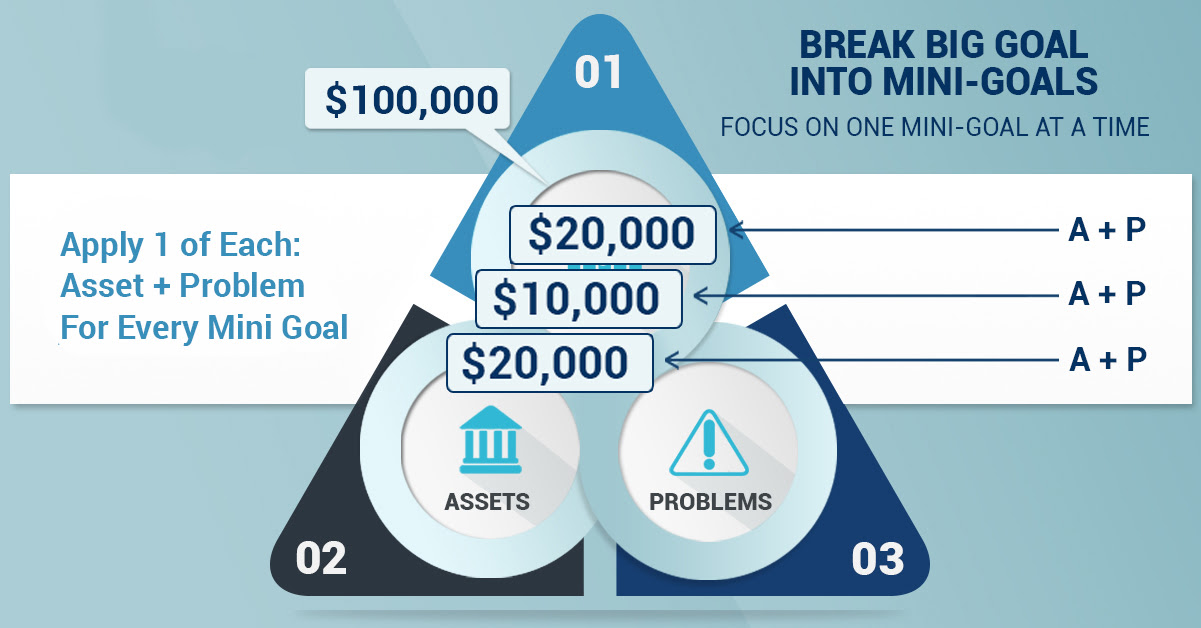
What Steve needs to do is draw a staircase on his Peg Diagram.

Here’s how it works:

  • Each step of the staircase is ONE of his goals.
  • Each step will use ONE of his assets which will resolve ONE of his problems.

For Steve, he’ll have a staircase with steps that are worth $20,000, $10,000 and $20,000. (Steve should actually break it down even further, but this will give us a simple example to work with.)

Here’s how it looks on the diagram:


STEP 3: Put A Problem & An Asset On Each Step

Now what happens? How does Steve pull everything together into a plan?

Simple: he associates a problem and an asset with each step.

Doing this is a LOT easier than most people think! The problem-solving goes very fast at this point.

The first problem Steve should tackle is motivation. Motivation kicks in automatically for most people once they see results… but until results happen, motivation is usually zero!

Steve needs to use an asset that will get him quick results. The lowest hanging fruit available to him is working some overtime.

Peg Method


If he works an average of 10 hours of overtime each week, that will earn him an extra $18,000 over the course of the year.

It makes sense for him to deploy this asset first because he will see an immediate increase in each paycheck. Within a month, the amount in his bank account will be higher. That will motivate him to keep going!

Steve brings down his mini-GOAL ($20,000), his PROBLEM (Motivation) and matches it with an ASSET (Overtime).

Peg Method

Now here’s something important about this step: Steve should not worry about (or even THINK about) $100,000! The BIG goal should be OUT of his mind.

All he should focus on is that first step.

It’s easy to see that simply matching a problem + an asset with a goal can really open up someone’s mind.

It takes away the clutter. It eases the pressure. It allows us to relax. The stress goes away. We’re focused on chunks. We’re eating the elephant, but it no longer looks overwhelming, intimidating or discouraging.

This exercise can also eliminate a lot of negative self-talk.

We all have that little nagging voice in our head that whispers, “Ugh, this is such a BIG goal… it’s so HARD… I’ll NEVER do it.” With The Peg Method, we forget about what we CAN’T do. Instead, we’re focused on a small goal which we CAN do.

Here’s a little diagram that shows what’s really happening. We’re just taking a list of Goals, Problems & Assets and arranging them on the staircase.

Peg Method

Every step on the staircase is an attainable goal.

STEP 4 – Repeat For Each Step On The Staircase

Watch this Success Weekly clip where Anik takes a deep dive into mini-goals and how to apply The Peg Method.

Now back to Steve’s goal. He’s going for the second step on the staircase: $10,000.

Peg Method

  • He brings down another goal: $10,000.
  • He brings down a problem: no promotion opportunities.
  • He brings down an asset: his social media skills.

Why does Steve need to deploy this part of the plan and not just be content with working overtime?

Because there’s not much more Steve can do with the “overtime asset”. There’s only so many hours of overtime he can work, and there’s no room for promotion. So he MUST get some side income going.

Luckily Steve understands social media tools like Facebook and Twitter. He can help companies use these tools to market their products and services.

Should Steve go out and try to get a job as a social media manager? Maybe. But only large companies hire somebody full-time to manage their social media. Most businesses contract it out to agencies or individuals. But this actually gives Steve an incredible opportunity: he can approach local businesses and offer to manage their social media for them.

In today’s market, he should be able to get at least $500/month per client.

Just getting 2 clients would vault him over the $10,000 mark for the year.

This is also a relatively easy strategy for Steve. Because he knows what he’s doing, 2 clients would require only an hour or so each day. And all he needs is a computer and internet connection. But here’s what’s really important: social media management could grow into full-time work. It could replace Steve’s current job.

How? His per hour rate is much, much higher with the social media stuff. Once again, Steve is matching an asset against a problem, and using that to achieve a mini-goal.

PROBLEM (dead end job) + ASSET (social media skills) = $10,000 down!

Peg Method

Now, has Steve stopped his other work? Heck no!

By now Steve’s riding the momentum he created with taking more overtime. He’s already got money coming in from that.

So at this point, he’s simply ADDING something to the mix.

He’s utilizing a new asset to solve an old problem AND achieve a mini-goal at the same time. Nice, huh?

Finally let’s do one more step on Steve’s staircase.

Peg Method

  • He brings down another goal: $20,000.
  • He brings down a problem: his introversion.
  • He brings down an asset: his friend Logan.

It’s obvious that the best way for Steve to double his income is to grow his social media consulting and wean himself off his current job.

All Steve has to do is get more clients… but that means approaching businesses and selling his services. That’s not something Steve is naturally good at. Frankly, cold calling a lot of different businesses is NOT something Steve wants to do!

Luckily, Steve has a friend who has connections: Logan.

Logan can ask around his network. He can find out who needs social media services. He can link those people up with Steve. No cold calling required!

Steve simply needs to follow through on the opportunities and do great work for his clients. The Peg Method shows how this is totally doable.

We overcome what looks like a huge problem with an asset that makes it melt away. By adding just 4 clients, he’ll earn the extra $20,000 he needs to top $100,000 in annual income.

Even cooler, Steve could set himself up to be self-employed doing something he’s passionate about. And all because he recognizes that Logan — an asset — can help him overcome one of his biggest obstacles.

Peg Method

See how The Peg Method gets us to think creatively about the assets we already have?

It even gives us ideas for more assets we need to acquire. Imagine what could happen for Steve if he had 2, 3, or 4 well-connected friends like Logan!

I could keep going, but I think at this point everyone can see how to use The Peg Method.

Simply write down…

  • Everything we’re trying to accomplish (Goals)
  • Everything we have that can help (Assets)
  • Everything standing in our way (Problems)
  • Then just sort it all out on the staircase!

Now let’s go to the next level and see if The Peg Method can help achieve an even more ambitious goal…

Let’s dive into the second example: making $1 million.

Lauren owns a moderately successful Internet Marketing business that makes her around $100,000/year. That’s a decent chunk of change, but Lauren wants more. In fact, she wants to become a millionaire — and fast.

What’s step #1? Creating those 3 columns.

THE GOAL: Earn $1 million during the next year.

With the goal in mind, Lauren should list out the biggest problems and assets associated with it, like the previous example. To keep this post short, I’ll simplify them a bit.

PROBLEMS standing in the way:

  • Small list. In the Internet Marketing world, it’s difficult to have huge product launches without a large email list. Unfortunately, Lauren’s email list is very small.
  • No time! Her schedule every day is already maxed out. She doesn’t have more than an hour or two to work on a new project.
  • Motivation. While Lauren wants to earn a million dollars, sometimes she doesn’t feel like doing the work required to get it.

Now for her ASSETS. What are the things working for Lauren?

ASSETS that can help:

  • Her friend Jamie, who owns a multi-million dollar Internet Marketing business. She is constantly launching new products and could be open to collaborating on some with Lauren.
  • A shelved product that was never launched. Lauren created this product a while back, but she got tied up with other stuff before she could launch it. While it needs a little bit of work, it is almost ready to go.
  • Lauren LOVES meeting new people. She can walk into any room and instantly make connections.

Here’s a picture that shows her lists, with the big goal at the top.

Let’s Peg It!

Alright, we’ve got that imposing $1 million goal. The first thing Lauren needs to do is break it up.

Remember…

  • Each step of the staircase is ONE of her goals.
  • Each step will use ONE of her assets, which will resolve ONE of her problems.

For Lauren, each stair will represent $250,000. Again, she should actually break it down even further, into more granular goals. But I’ll do the 30,000 foot overview to simplify the example.

Here’s how it looks on the diagram:

Now it’s time to start pairing up problems with assets.

The first problem Lauren should tackle is motivation. It’s important to get the ball rolling since it’s easier to KEEP moving than it is to START moving.

So Lauren needs to use an asset that will get her quick results. That means launching a product. The good news is that she’s got one ready to go sitting on the shelf. So it makes sense for her to deploy this asset first.

Peg Method

Within a month, she’ll see money flowing into her bank account. That should motivate her to keep going and make even more!

Lauren brings down her mini-GOAL ($250,000), her PROBLEM (motivation) and matches it with an ASSET (shelved product).

Peg Method

Remember: Lauren should not worry about (or even THINK about) $1 million! The BIG goal should be out of her mind.

All she needs to focus on is that FIRST STEP.

Now back to Lauren’s goal. She’s going for the second $250,000 step.

Peg Method

  • She brings down another goal: $250,000.
  • She brings down a problem: her lack of time.
  • She brings down an asset: her friend Jamie! The 2 of them will collaborate on creating and launching a new product.

Jamie is a terrific asset to help Lauren overcome her time issues. Yes, they can split the work. But more importantly, Jamie brings her own assets to help.

Working together, they can create and launch a product TOGETHER that will help both of them do MORE!

Once again, Lauren is matching an asset against a problem to achieve a mini-goal.

PROBLEM (lack of time) + ASSET (partnership with Jamie) = $250,000 down!

Peg Method

Finally let’s do one more step on Lauren’s staircase.

Lauren’s small mailing list is a significant liability. By increasing the size of her mailing list, Lauren can reach out to more potential customers. This means any time she launches a new product, she can sell to a bigger audience. That means more money with each product launch. 

Peg Method

  • She brings down another goal: $250,000.
  • She brings down a problem: her small list.
  • She brings down an asset: her networking skills.

Lauren will already be growing her list by following through on the first 2 steps. But if she really wants to start making the big bucks, she’ll need to do more.

This is where networking comes in. Effective networking can connect Lauren with other entrepreneurs with big lists of their own. If she nurtures these relationships and offers their lists good deals, that opens up opportunities for bigger product launches. That means a LOT more momentum!

Lauren has an important networking asset: she is an outgoing woman. She can walk into a room full of strangers and start connecting with them.

Lauren simply needs to find more networking opportunities. She already possesses a natural asset — her personality — that can connect her to people who will grow her business. Heck, all Lauren has to do is USE a trait she already possesses and make some profitable connections!

Peg Method

Just like that, The Peg Method takes an incredibly ambitious financial goal — earning $1 million — and breaks it down to make it more attainable. It all starts with making mini-goals.

See, most people tackle their wealth goals the wrong way. They trap themselves in longing and dreaming. They focus on the whole $200,000, $500,000 or $1 million.

But how do we make $50,000? Or even $100,000? And actually keep the money we make?

And what’s standing in our way — what’s preventing us from making that money? Do we even know what led to our current financial position in the first place?

Many people spend a bunch of money on different “make money” programs and get absolutely nowhere with them. But it’s not because they have the wrong information.

It’s because they have absolutely no idea what their REAL obstacles are. And they don’t know how to find the assets they need, let alone deploy them in an effective way.

Our problems — and our assets — are all unique.

So we need a set of steps, an abundance mindset and way to put all that good stuff into a plan that feels right for who we are as individuals.

Without that, it’s easy to keep poisoning our minds with big, fuzzy, vague wishes that never actually get anywhere.

So ask these questions…

  • Do I know what my real problems are?
  • What do I have for assets?
  • What do I have to work with?
  • What am I good at?
  • What stands in my way?

To make money, we can’t just do what someone else tells us to do! What THEY specifically did to make money might not work for us. We’re all different people. We all have different assets and different strengths. Our techniques might not work for others.

If we try to be exactly like someone else, we could just be fighting our own inner guidance.

But The Peg Method helps us to stop fighting ourselves. It shows us what we want, what we have and the EXACT STEPS we need to get what we want without fighting ourselves and without beating ourselves up because we can’t do everything right NOW.

The PEG Method And New Year’s Resolutions

As most people know, new year’s resolutions rarely work.

And it’s because of a few things:

  • People have vague goals
  • People don’t have a clear plan or system to implement
  • Goals can be overwhelming

Now can you see why most new year’s resolutions fail miserably? And what’s the best way to avoid this fate? The PEG Method!

The PEG Method makes it simple to achieve any goal.

And it doesn’t have to be complicated.

Using the PEG Method is simple too. Here are the steps again…

Pretty simple, right? And if you need more clarity, go back to the detailed explanations and examples above.

Start 2018 off on the right foot.

Take a few minutes to list your goals, problems and assets. Draw a staircase. Put a problem and asset on each step for each goal. In just a few minutes, you have a more actionable plan of attack than 99% of people.

Now start taking action.

If this post was valuable, please pass it along to friends, family and anyone else who can benefit 🙂


[Read More ...] http://ift.tt/2mIaMLZ